Explicit memory refers to the knowledge or experiences that can be remembered and with this type comes with two types within explicit. There is episodic which is firsthand experiences we have had and there's semantic which is our knowledge of facts and concepts about the world. Now you're probably at this point like what the heck does that mean. So an example of both would be your high school graduation day or maybe your big 18th birthday would be a prime example of episodic and then simply knowing that 2 plus 2 is 4 or that the library has books within it.

Implicit memory refers to the influence of experience on behavior, even if the individual is not aware of those influences and of course there are three different types of implicit memory, procedural, classical conditioning effects, and priming. Procedural memory is based on our often unexplainable knowledge of how to do things. For example, when we walk around, eat, or play video games, that's an example of procedural memory because it allows us to perform complex tasks even if we can't explain to others how we are doing it. There's no way to really teach someone how to walk other than just learning to actually do it. The second type I listed was classical conditioning which was what my last blog was over. It is demonstrated when a conditioned stimulus begins to create the same response as the unconditioned stimulus did before learning. Finally the last one listed is priming which is changes in behavior as a result of experiences that have happened frequently or recently. So an example of priming would be knowing the concept of kindness by presenting people with words that correlate with that and then people who are primed with the concept tend to act more kind. I'm not sure if that made sense to y'all, but feel free to look up some more on that ;)
Now like I said in the beginning, there are different stages of memory: sensory, short-term, and long-term memory. Basically when developing a memory it goes through these stages, but not always do all the things you retain make it through all three stages.
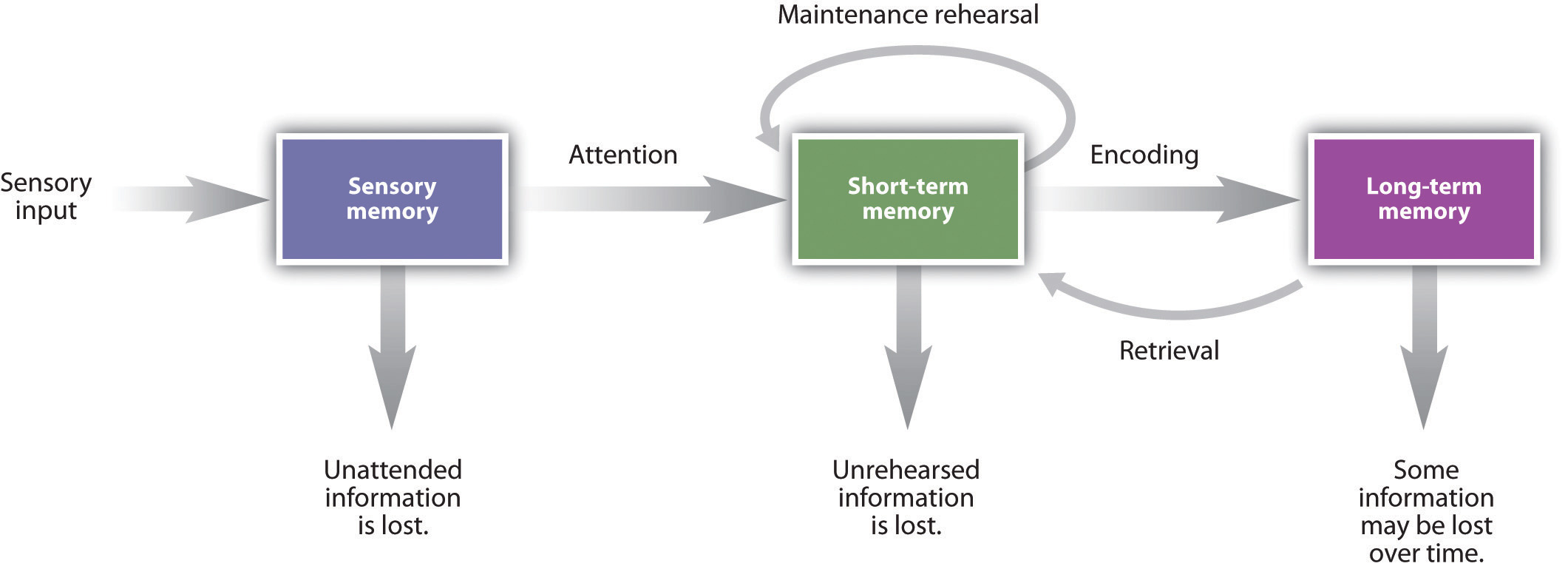
Sensory memory is the brief storage and it only last for a very, very short period of time before it is passed on for more processing if it's not already forgotten. Most of the time, the information that goes into sensory memory is forgotten, but when we actually sit here and pay attention to some of the information and really try to remember it, it passes into short-term memory (STM). STM is the place where small amounts of information can be temporarily kept longer than sensory memory but not any longer than a minute. So a common an example that most people would think of when thinking about short-term memory would be Dory from Finding Nemo. She suffers from short-term memory loss as most of y'all probably know...lol :) Now last but not least, there's long-term memory. In order for this to be retained into memories, we have to want to remember by encoding and storing and then retrieving.
So with this blog this week there's an experimental task and it's over the effects of creating a false memory. This blog I'll kind of give you a background of what exactly that means before my next post with the experiment. Many different psychologists have defined false memory so there isn't a very distinct definition, though there was one that I found pretty accurate in my opinion. M.K. Johnson said, "A false memory is a mental experience that is mistakenly taken to be a veridical representation of an event from one's personal past. Memories can be false in relatively minor ways and in major ways that have profound implications for oneself and others." So you're probably wondering what the heck causes anyone to falsify a memory. Factors that can falsify memories can include misinformation and misattribution of the original source of the information. Also, existing knowledge and other memories can interfere with the formation of a new memory, causing the recollection of an event to be mistaken of entirely false (VeryWellMind). In my experiment, I tested the memory of my friend Paige to see if she would falsify anything, but y'all will see those results in my next blog!
Well that's just about all I got on the mems so stay tuned for my experimental blog coming up ;)
xoxo, court :)
Sources ;)
Well that's just about all I got on the mems so stay tuned for my experimental blog coming up ;)
xoxo, court :)
Sources ;)
Mastin, Luke. “What Is Memory.” What Is Memory? - The Human Memory, Human-Memory.net, 2010, www.human-memory.net/intro_what.html.
Cherry, Kendra, and Steven Gans. “How Your Brain Can Create False Memories.” Verywell Mind, 18 May 2017, www.verywellmind.com/what-is-a-false-memory-2795193.
Cherry, Kendra, and Steven Gans. “How Your Brain Can Create False Memories.” Verywell Mind, 18 May 2017, www.verywellmind.com/what-is-a-false-memory-2795193.


There are so many different kinds of memory! Thank you for listing them, as it was very beneficial to know all of them! My favorite one would be short term memory, how you could forget your life in minutes. It's such a sad, but fascinating idea. Also, I didn't even know how big of an impact behavior can have on our memory. Anyways, this was a very well done and descriptive blog that I really enjoyed reading!
ReplyDeleteHey girly, it was interesting to read your blog, as per usual. It really is amazing how the brain works and how it stores memories (or doesnt) I like how you went in detail over the different kinds of memory. I focused more on the different diseases of the brain so it was cool to get to read about this. Love ya!
ReplyDeleteHey Courtney good job on this blog post! it is very well explained and pretty lengthy compared to others so I know you took your time writing it and really understood the information for this module. It made it really easy to understand the different types of memory because of how you listed them.
ReplyDeleteHello Courtney! I loved your blog about memory. You explained everything so well and went in depth. After reading your blog I feel like I understand things about memory that I didn't before. Great work!
ReplyDeleteHey Courtney! Your blog was very informative! There are so many different kinds of memory! This is my first time seeing your blog, and I like how your blog is creative! I definitely like how you make your blogs actually seem like blogs instead of an assignment. That is something I need to work on doing! I am looking forward to reading more of your blog posts! Good job!
ReplyDelete