 Ivan Pavlov focused on classical conditioning, a form of learning
in which animals or people make a connection between two stimuli that have occurred
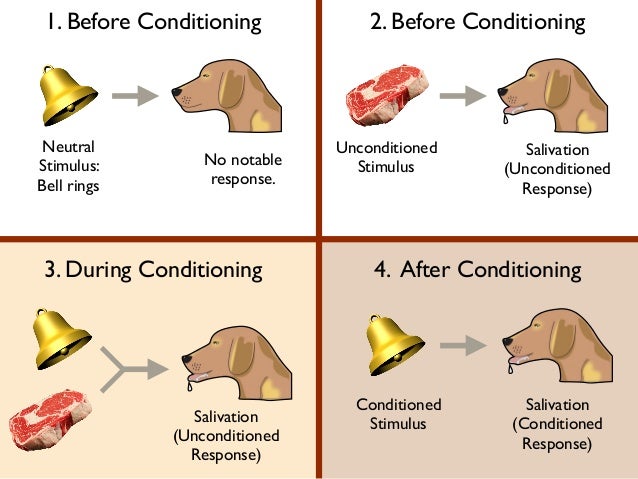
together such that one predicts the other. So for example, Pavlov studied the anticipatory salivation in dogs. He first noticed the neutral stimulus which causes no response at all. He used a bell which demonstrated a neutral stimuli and it didn't create salvation from the dog. The next thing he found was the unconditioned stimulus which causes a response automatically without having to learn. In this instance, food is a natural biological reflex for salivation in dogs. The dog's salvation is called an unconditioned response because it happens naturally. Pavlov then paired these two conditions together and associated the bell with food to see if the dog would begin to salivate and it did. This turns the bell into a conditioned stimulus which now has a response of a conditioned response because this is acquired through learning. Now the dog will salivate to the ring of the bell because it learned from the conditioning that food is directly related to the ring.
Ivan Pavlov focused on classical conditioning, a form of learning
in which animals or people make a connection between two stimuli that have occurred
together such that one predicts the other. So for example, Pavlov studied the anticipatory salivation in dogs. He first noticed the neutral stimulus which causes no response at all. He used a bell which demonstrated a neutral stimuli and it didn't create salvation from the dog. The next thing he found was the unconditioned stimulus which causes a response automatically without having to learn. In this instance, food is a natural biological reflex for salivation in dogs. The dog's salvation is called an unconditioned response because it happens naturally. Pavlov then paired these two conditions together and associated the bell with food to see if the dog would begin to salivate and it did. This turns the bell into a conditioned stimulus which now has a response of a conditioned response because this is acquired through learning. Now the dog will salivate to the ring of the bell because it learned from the conditioning that food is directly related to the ring.So something that really stuck out to me in this chapter would have to be the fact that classical conditioning can be used in treatment for physical disorders. The example in this chapter was individuals with serious allergies took an effective allergy drug and then quickly drank an unusual drink. So after drinking the drink several times with the allergy drug, it eventually coincided together. The doctor then just made the patients drink the unusual drink on its own and they directly related it back to their symptoms of their allergies. Now after the drink being a neutral stimulus, it was now a medical effect in these patients because of its learned association with the drug that had the effect. I think that this is important because when you directly correlated something with another it can either give you a bad memory or good memory.
A real world example that I have run across would actually be from a couple months ago. During our little ice break, my friends and I went up to San Antonio and on the drive back we passed Comanche and I really cringed and instantly was making sure I was going the speed limit. Now one weekend, my best friend Kourtney and I went up to College Station to visit her sister and whatnot. Well on the drive back I got a speeding ticket in Comanche. Therefore,
unconditioned stimulus: getting a speeding ticket
conditioned stimulus: seeing the Comanche sign
unconditioned response: cringing and negative feelings
conditioned response: going the speed limit and be cautious
Well thats all I got on learning and how a certain study came about. I hope y'all had fun or somethin like that while reading this ;)
xoxo, court :)
Sources :)
Chapter 6 - Psychology Book :)


No comments:
Post a Comment